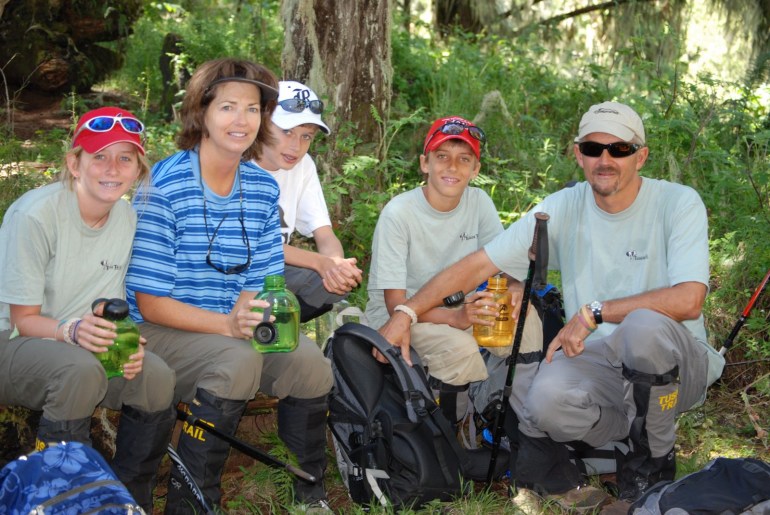
 The next morning we are up at 6:30 a.m. for breakfast in the mess tent. Most everyone in our group has been awake much of the night, except for our kids. Everyone is still getting used to the effects of Diamox, which everyone in our group is taking. It is a drug that is supposed to improve the ability of your body to adjust to the altitude. It has significant side effects though, including being a strong diuretic.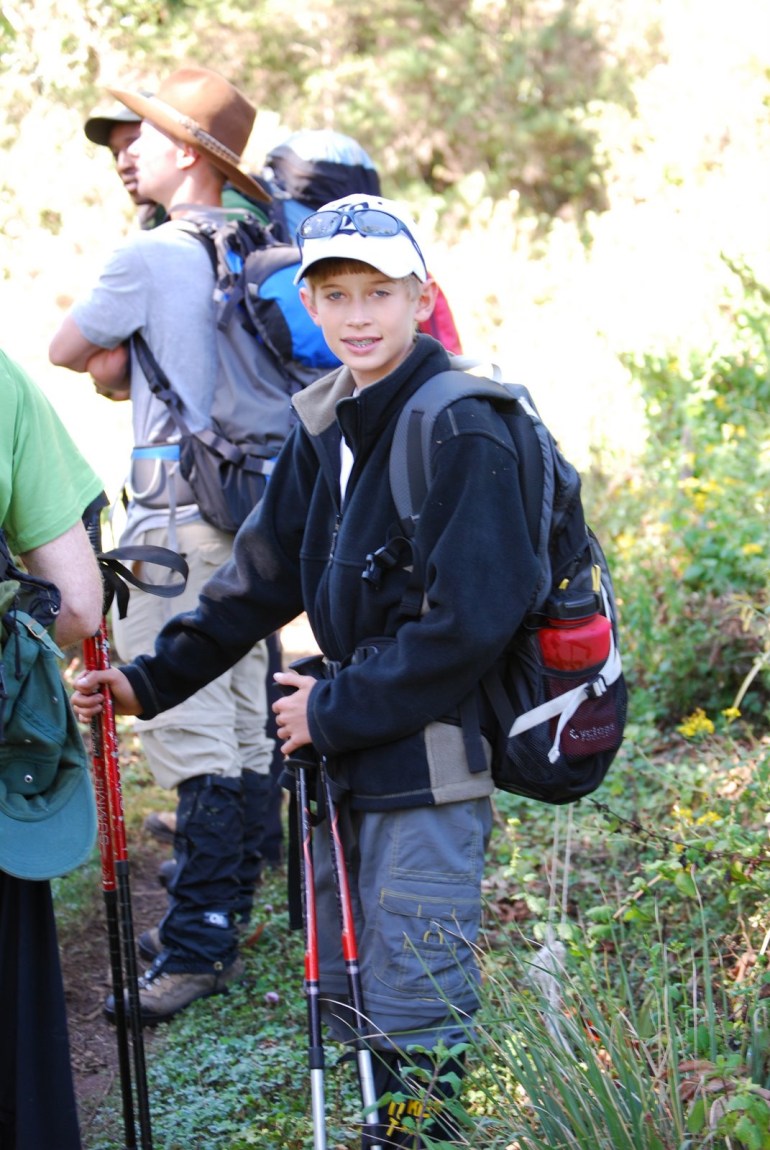
We leave the Forest Camp around 9:00 a.m. We are headed to the next camp site on the Shira Plateau at 11,500 feet, a 7 hour, mostly uphill, hike. We start out hiking through the remaining rainforest towards the large Moorland zone. After a few hours of hiking, we leave the tall trees and dense foliage of the rainforest. We see mostly heather and other shrubs. There also are many grasses, flowers, and small bushes growing in the area. We do not see any large animals, but lots of birds. The Moorland zone has several plants growing that are found only on the sides of Kilimanjaro at this altitude. They include the Senecio kilimanjari and the lobelia. Photos of both are in the Kilimanjaro slideshow. There are few mammals that live in the Moorland zone. The few that appear there are just passing through. We do not see any. After lunch, which we eat on the trail, we hike up a very steep trail to reach the top of the Shira rim, where we get to see the top of Mt. Kilimanjaro for the first time. It looks very high and a long way off. Our campsite is downhill from the Shira ridge in the Shira plateau or crater about 1 hour away. We arrive at the campsite at about 4:00 p.m. Several in the group have not drunk enough water during the day (including Hal) and have dehydration headaches when we get to the camp. Our guides suggest that we drink 4 to 5 liters of water a day. Some in our group are drinking 8 to 9 liters a day. The Shira crater once was the third volcanic peak on the mountain but has since erupted and collapsed inward and now only part of the eroded crater rim remains. That night it is clear and very cold, well below freezing, and everything left outside the tents freezes. But as soon as the sun hits the campsite in the morning it warms up dramatically.
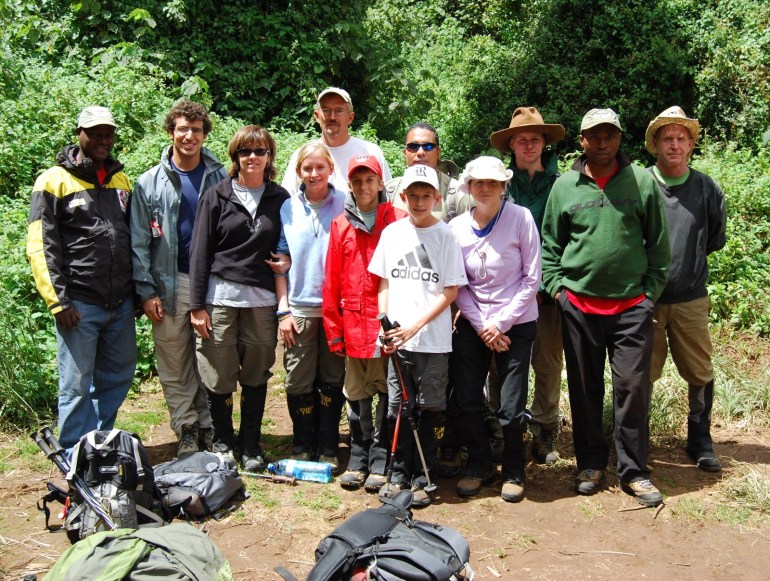 The next day, Friday, August 24, we are met at the hotel by our guides in an Austrian 6 wheel all terrain vehicle (similar to a Hummer) that holds 14 people in the back. We all get into the back of the truck with our gear. We drive for about 3 hours to reach the Londorosi Entrance Gate, which is the western entrance to the Kilimanjaro Park. After checking in with the Tanzanian park service about noon, we drive to the trailhead at about 7000 feet, where the road ends and the trail begins. It is not much of a road and is mostly mud. Our all wheel drive truck is slipping back and forth on the way up to the trailhead, where we unload all of our gear. The trail starts in the forest zone of Kilimanjaro. While hiking through the rain forest, we see several troops of Colobus Monkeys on the trail and signs of elephants, lots of dung and trails that they use to move through the forest, but we do not see any elephants. The elephants are hard to see because of the dense jungle foliage and because they shy away from humans. Buffalo, baboons, and several types of antelope also live in the forest zone. Many other types of mammals, including leopards and rhinos lived in the forest zone in the past, but they are now extinct on the mountain. The forest zone encircles all of Kilimanjaro between 5900 feet and 9200 feet. Most of the water on Kilimanjaro originates in the forest zone. We reach our campsite, the Forest Camp (at 9100 feet), around 5:00 p.m. That night, we eat dinner for the first time in the mess tent. Like all of the meals to come, it is very good. It consists of hot soup, pasta, potatoes, and fruit. After dinner, our guides bring in a birthday cake to the mess tent to celebrate Marsha’s birthday. Unknown to us, the guides carried the cake up the mountain from Moshi. They bring it into the mess tent singing “Happy Birthday” in Swahili. It is a nice end to the first day. After that, everyone goes back to their tent. The temperature drops rapidly at night on Kili. We sleep in 2 person waterproof tents in sleeping bags rated to minus 20 degrees F, with Marsha and Haley in a tent, Cameron and Travis in a tent, and Hal in a tent.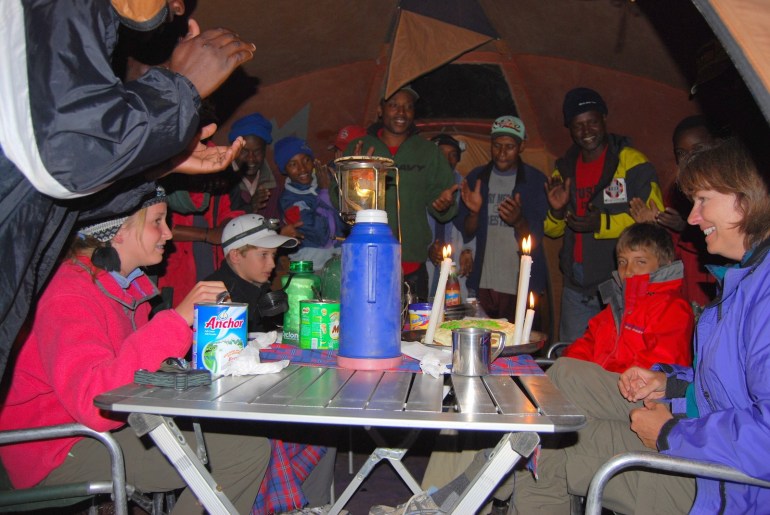






 Cayuse
You must be logged in to post a comment.